If you’ve ever found yourself hunched over a desk at 2 a.m., frantically rereading notes and hoping everything somehow sticks until morning, you’re not alone. Cramming is practically a student tradition. It feels productive, almost heroic—one long, intense session where you conquer a mountain of information at once.
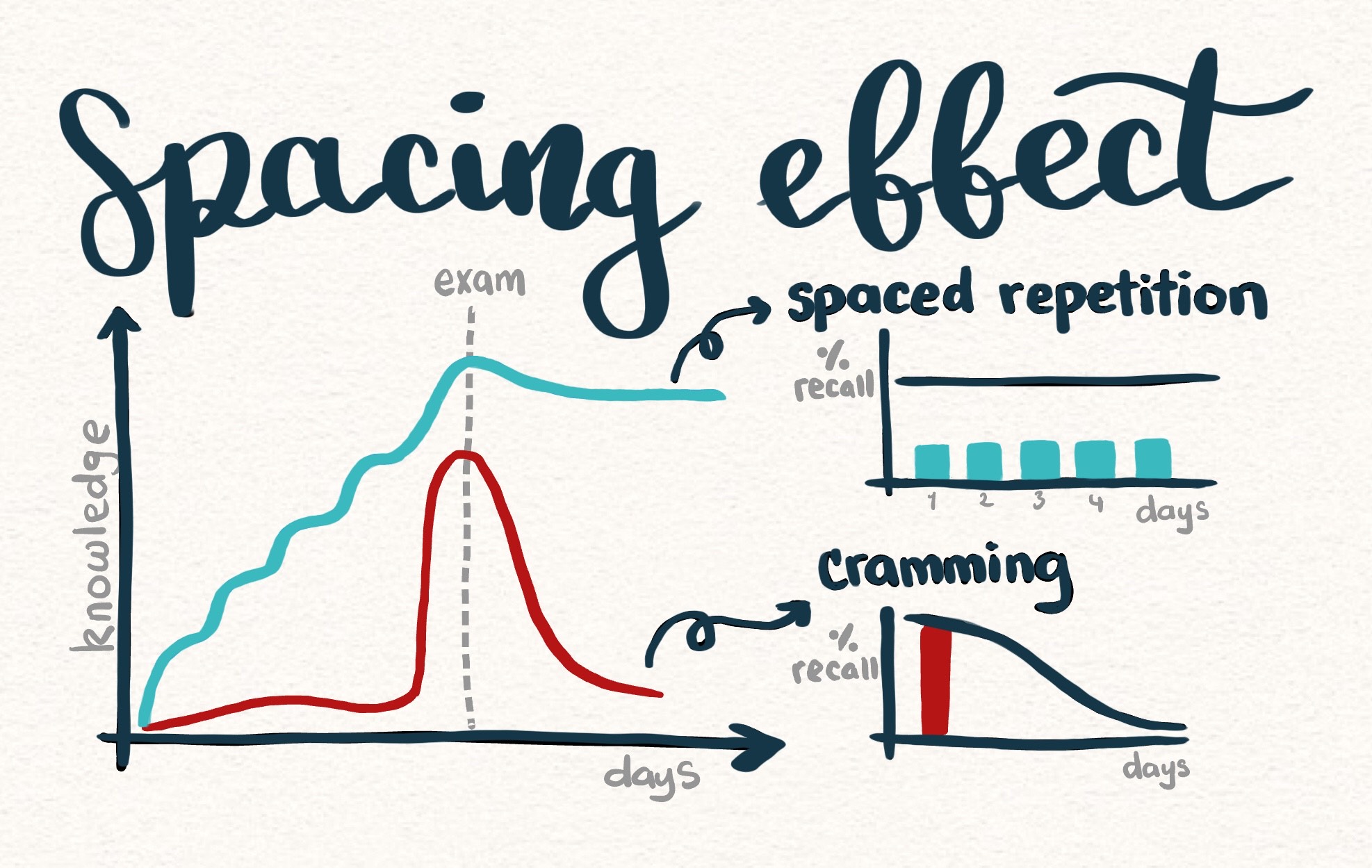
But here’s the uncomfortable truth: cramming tricks you into thinking you’ve learned something when, in reality, you’ve only activated your short-term memory. Within days—sometimes even hours—most of it is gone.
Meanwhile, spaced repetition quietly and steadily outperforms cramming in every scientific study on long-term learning. It works with your brain instead of against it, builds real retention, and drastically reduces stress. Yet many students still default to cramming simply because it feels fast.
Let’s break down why spaced repetition works so well, what the science says, how to use it in real life, and why it should become your new go-to strategy for mastering any subject.
The Science of Remembering (and Why Cramming Doesn’t Stand a Chance)
Our brains aren’t designed to absorb huge amounts of information all at once; they’re wired for gradual strengthening of memory through repeated exposure. When you cram, your brain temporarily stores facts in short-term memory, which is great for next-day tests but terrible for long-term learning.
Research stretching back to Hermann Ebbinghaus shows that memory fades according to a predictable pattern known as the forgetting curve. Without review, newly learned information decays rapidly—sometimes by 70% within the first day.
Spaced repetition interrupts this forgetting curve by revisiting information at exactly the moment you’re beginning to lose it. That “almost forgotten” moment is key: retrieving information under mild difficulty supercharges retention.
Why your brain loves spacing
Modern neuroscience explains why spaced repetition is so powerful:
1. It strengthens long-term potentiation (LTP) LTP is the process where repeated activation of neural pathways strengthens the connections between neurons. Spacing out your study sessions activates these pathways multiple times, helping memories become stable and long-lasting.
2. It leverages memory consolidation during sleep Between study sessions—especially during sleep—your brain replays and reorganizes new memories. Cramming gives your brain one single opportunity for consolidation. Spaced repetition gives it many.
3. It avoids cognitive overload Cramming battles attention fatigue. After a certain point, your brain simply can’t take in more information. Spaced learning, on the other hand, is lightweight and sustainable.
The result?
Spaced repetition produces deeper understanding, stronger memories, and better transfer of knowledge to new contexts (like solving unfamiliar problems or applying theory in real-life situations).
How Spaced Repetition and Cramming Actually Compare
Even though the science is clear, the practical differences are what students feel most strongly. Below is a simple, realistic comparison of both techniques.
Aspect
Cramming (Massed Practice)
Spaced Repetition
Memory Retention
Drops sharply after 1–2 days
Strong long-term retention
Cognitive Load
Very high, exhausting
Low per session, manageable
Time Efficiency
Requires frequent re-learning
Saves time overall
Stress Level
High—usually last-minute
Low—predictable routine
Understanding
Surface-level
Deep, conceptual
Ideal Use Case
Only for next-day tests
All long-term learning
Motivation
Burns out quickly
Builds naturally with progress
Neural Impact
Weak memory pathways
Strong, stable pathways
This isn’t just a theoretical difference—students who switch from cramming to spaced repetition consistently report better grades, more confidence, and far less anxiety around exams.
Real-Life Ways to Use Spaced Repetition Without Overcomplicating Your Study Routine
The beauty of spaced repetition is that it doesn’t require complicated charts or advanced study theory. You just need consistency and a system that helps you revisit information at the right time.
Here’s how you can make it work.
Build a simple spacing schedule
Classic spacing intervals that work for most learners include:
• Day 1 → Day 3 → Day 7 → Day 14 → Day 30 • or a shorter cycle for urgent learning: 1 hour → 1 day → 3 days → 1 week → 2 weeks
You can adjust the intervals depending on the difficulty of the material. The rule is simple: review the material before you forget it, not after.
Focus on active recall instead of passive reading
Spaced repetition works only when you test yourself, not when you reread.
Try these methods:
• Close your notebook and explain the idea from memory • Recreate diagrams or formulas without looking • Solve a practice problem without checking examples • Teach the concept to a friend (or pretend student)
The harder your brain works to retrieve the information, the stronger that memory becomes.
Use tools that automate your spacing
Digital platforms are especially effective:
• Anki — the gold standard of spaced repetition • RemNote — combines note-taking and spaced reviews • SuperMemo — advanced algorithm with detailed control • Quizlet Long-Term Learning — accessible and user-friendly • Language-learning apps (Duolingo, Memrise) — spacing built in
These tools track when each concept is due for review based on how well you remembered it last time.
Break information into small, memorable pieces
Spaced repetition works best when you study atoms of knowledge, not entire chapters. Convert content into bite-sized units such as:
• definitions • key steps in a process • formulas • historical dates • vocabulary • problem types
This makes your study sessions short but powerful.
Mix new material with old
A typical spaced repetition session might look like:
• 10 minutes reviewing “due” cards • 10 minutes learning something new • 5 minutes turning new information into spaced items
This balance keeps learning fresh without overwhelming you.
Use micro-sessions throughout the day
Spaced repetition thrives on short bursts:
• reviewing flashcards while commuting • 5-minute refresh between classes • revisiting vocabulary during lunch
These tiny investments add up to huge gains over weeks.
Sleep strategically
Because sleep plays such a major role in memory consolidation, try pairing a short review before bed with a follow-up review the next morning.
This simple technique can double retention levels.
Building a Habit That Lasts: Making Spaced Repetition Part of Daily Learning
Spaced repetition only works if you stick with it—but thankfully, it’s one of the easiest study habits to maintain once you start seeing results.
Here’s how to keep it effortless and sustainable.
Create a predictable rhythm
Great habits start simple:
• Review daily for 10–15 minutes • Add new material once or twice a week • Do a monthly cleanup to remove mastered content
Consistency—not intensity—is what drives results.
Keep your study materials clean and minimalistic
The best spaced repetition decks use:
• short prompts • simple phrasing • one concept per card • clear questions rather than paragraphs
Overloading a single card weakens learning and creates unnecessary friction.
Encode information in multiple ways
Your brain loves variety. Strengthen memories with:
Each form acts as a “memory handle” your brain can grab onto later.
Use it beyond school
Spaced repetition isn’t just for exams. It works for:
• new languages • math and science concepts • anatomy and medicine • law and terminology • programming syntax • professional certifications • music theory • geography or history facts
Anything that requires long-term retention benefits.
Combine spaced repetition with interleaving
Interleaving—switching between topics instead of studying one in isolation—makes spaced repetition even more powerful. It prevents your brain from falling into autopilot mode and forces flexible understanding.
Celebrate visual progress
Whether it’s a streak, a graph, or a “completed” badge, progress tracking fuels motivation. Spaced repetition tools do this automatically, which is one reason people stick with them longer than traditional study routines.
Understand—and accept—the feeling of forgetting
Forgetfulness isn’t failure; it’s precisely what spaced repetition depends on. When something feels hazy, the next review becomes significantly more effective.
Once you embrace this idea, spaced repetition becomes far more natural.
Final Thoughts: Spaced Repetition Isn’t Just a Technique — It’s a Smarter Way to Learn
Cramming has emotional appeal. It feels intense, productive, and familiar. But it doesn’t translate into mastery. It produces short-term confidence and long-term forgetting.
Spaced repetition, meanwhile, aligns perfectly with how the brain naturally learns. It strengthens neural pathways, builds durable knowledge, reduces stress, and saves time—often dramatically.
The real power of spaced repetition isn’t in the algorithms or apps. It’s in its ability to transform learning from a frantic, last-minute struggle into a calm, structured process where information truly sticks.
Once you experience the difference in your memory, your grades, and your confidence, it becomes nearly impossible to go back to cramming.
In today’s educational environment, students face increasing demands. The volume of information continues to grow, learning timelines accelerate, and independent work has become critical for success. In this context, one of the most essential factors for effective learning is self-regulated learning (SRL) — a student’s ability to manage their own learning process, set clear goals,…
Modern students face high levels of academic stress, driven by curriculum demands, deadlines, exams, and competition. Chronic stress negatively affects cognitive functions, motivation, and overall mental health. In recent years, research in psychology has highlighted the importance of emotional regulation — the ability to manage emotions and adapt to stressful situations — as a key…
Project-Based Learning (PBL) has emerged as one of the most effective educational strategies in recent decades. Unlike traditional teaching methods, where students primarily listen to lectures and take tests, PBL places learners at the center of the process: they solve real-world problems, create projects, and apply knowledge in practice. This approach not only boosts motivation…





 February 21, 2026
 views
views